
Illegal Trade Bulletin: Issue 11
World Ozone Day and Global Action Against Illegal Trade
This World Ozone Day celebrates almost 40 years of the Montreal Protocol and 10 years of its Kigali Amendment, under the theme of “global action for a cooler planet.” Since its adoption in 1987, the Montreal Protocol has demonstrated the power of science-based policy and sustained international cooperation. Widely hailed as the world’s most successful international environmental treaty, its implementation has phased out 99% of ozone-depleting substances (ODS). It is expected to prevent approximately 443 million cases of skin cancer and 63 million cataract cases in the U.S. alone. Evidence of ozone recovery has been documented, and ozone protection efforts are estimated to have avoided 135 billion tonnes of CO2 equivalent emissions from 1990 to 2010. The Kigali Amendment builds on this success by phasing down climate-polluting hydrofluorocarbons (HFCs), with its implementation estimated to avoid up to 0.5°C of warming by 2100. It represents an opportunity to deliver major climate benefits while ensuring access to sustainable cooling.
However, emerging threats to the ozone layer’s recovery and the climate must be closely monitored and swiftly addressed to secure the full benefits of the landmark treaty. As ODS are phased out and HFCs phased down, shifts in supply and demand create powerful incentives for lucrative illegal production and trade of refrigerants. This issue of EIA’s Illegal Trade Bulletin looks back at a few of our investigations from the 1990s and 2000s that exposed the global black market ODS trade, and lessons for the ongoing HFC phase-down.
The Black Market in ODS
EIA’s undercover investigations in the 1990s and 2000s exposed the scale and sophistication of illegal ODS trade, demonstrating how criminal networks exploited weaknesses in national controls and international supply chains. By the mid-1990s, an estimated 20,000 tonnes of ODS were traded illegally each year, equivalent to approximately 20% of legitimate trade, prompting Montreal Protocol Parties to establish licensing systems to monitor trade, and prevent controlled substances from entering the black market. But EIA’s investigations have shown that controls are only as effective as their implementation, with smugglers continuously adapting their methods and routes to evade enforcement.
Chilling Facts About a Burning Issue (1997)
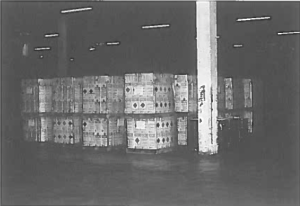
Seized CFC canisters having passed through Europe. (Source: U.S. Customs)
EIA documented widespread illegal trade in chlorofluorocarbons (CFCs) across the EU, enabled by weak licensing and penalties, and inadequate tracking of materials across borders. Ozone depletion was contributing to rapidly growing rates of skin cancer, with approximately one million cases annually in the U.S. alone. Key lesson: illegal trade prevention requires coordinated cross-agency and -border enforcement, including information sharing among customs, environmental authorities, and enforcement bodies, supported by centralized data, trained customs personnel, and strong controls at ports of entry.
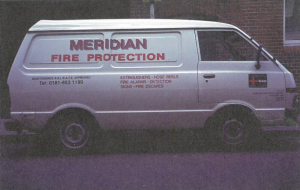
EIA’s investigation found illegal ODS used by several companies around Europe, including Meridian in the UK. (Source: EIA)
EIA revealed that virgin CFCs were illegally entering Europe via China in high volumes. The illegal imports were fraudulently marked as used refrigerant that had been recovered and recycled or reclaimed. Disposable refrigerant cylinders of banned CFCs were also improperly labeled as legal CFC-alternatives and illegally introduced into European commerce.
Key lesson: Illegal trade prevention requires coordinated cross-agency and -border enforcement, including information sharing among customs, environmental authorities, and enforcement bodies, supported by centralized data, trained customs personnel, and strong controls at ports of entry. EIA’s investigations exposed how illegal importers were able to establish shell companies for the sole purpose of illegal refrigerant trade.
Unfinished business: Continued Illegal Trade in ODS and Threat to Montreal Protocol (2001)
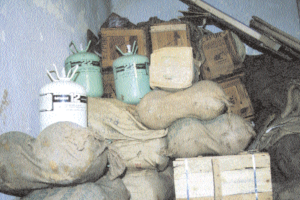
Part of a seizure in Calcutta of 281 cylinders of CFCs and hydrochlorofluorocarbons (HCFCs) smuggled from Bangladesh. (Source: EIA)
The Montreal Protocol had dramatically reduced global reliance on ODS and set out a path toward eventual ozone layer recovery. But the ozone layer was then more depleted than ever, with a record 2000 Antarctic ozone hole and Northern Hemisphere losses that raised concern its recovery could take longer than originally projected, especially if illegal ODS trade and non-compliance continued. This underscored that phase-out rules alone would not prevent illegal trade and more robust action was needed in licensing and tracking systems, real-time information sharing, and training of customs personnel to identify controlled substances.
Lost in Transit: Global CFC Smuggling Trends and the Need for a Faster Phase-out (2003)
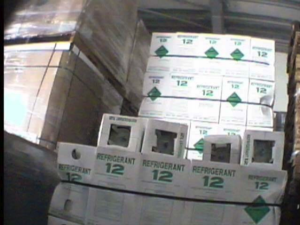
CFC-12 stored in Sing Swee Bee Enterprises Pte Ld. warehouse in Singapore. (Source: EIA)
This 2003 investigation exposed an elaborate smuggling scheme involving Singapore, South Africa, and the U.S. Newly produced CFCs were smuggled from Singapore, a major transit hub for international ODS trade, into South Africa via neighboring countries and supplied to the gold mining sector. The CFCs were then falsely documented as ‘used’ refrigerant recovered from mining equipment and sold to the U.S. as legitimately recovered refrigerant. The scheme exploited the higher value of recovered CFCs in the U.S. market, generating profits for those involved. After EIA’s undercover investigation, the South African authorities, in collaboration with the U.S., took steps to crack down on the illegal activities, carrying out a number of operations and seizing black market refrigerants. For example, one shipment declared 28.5 tonnes of “used” CFC-12 recovered from a gold mine, but the authorities found that the refrigerant capacity of the mine’s operating equipment added up to only 9 tonnes.
Key lessons
- Transit countries obscured the trail of material, as “in transit” goods faced minimal customs scrutiny, allowing smugglers to relabel and repackage.
- Brokers diffused accountability, as legitimate companies sold to brokers who had no obligation to verify end destinations, allowing (at the time) legally produced substances to be diverted to illegal buyers.
- Documentation loopholes enabled fraud: Tactics included fake records, mislabeling cylinders, contaminating virgin substances to make them appear “used,” and declaring tankers as only partially filled to evade import quotas.
These lessons remain relevant today, underscoring the need for effective enforcement to follow controlled substances through the entire supply chain, supported by information-sharing and collaboration across agencies and borders.
Under the Counter: China’s Booming Illegal Trade in ODS (2005)
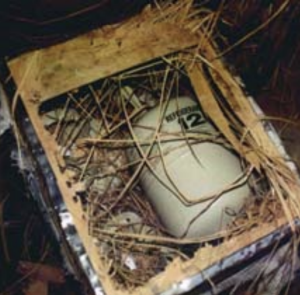
CFCs packed in tea chests, smuggled into India from Bangladesh, seized on route to Delhi. (Source EIA)
EIA exposed that Chinese CFC exporters were evading Montreal Protocol controls by mislabeling CFC-12 as legal substances, hiding it behind legitimate refrigerant containers, and relying on corrupt customs contacts. Key lesson: Verification is needed with the importing country that the shipment is legal and within quota prior to issuance of an export license.
Blowing It: Illegal Production and Use of CFC-11 (2018)

Staff at Dacheng Desheng Chemical Co., Ltd shows barrels containing CFC-11 (Source EIA)
The global black market in ODS did not disappear as controls tightened. In 2018, decades after CFCs had begun being phased out, EIA uncovered evidence of widespread illegal CFC-11 use in China’s polyurethane foam insulation sector, just six months after scientists detected unexpectedly high emissions of CFC-11 in the atmosphere. Nationwide enforcement and inspections cracked down on the illegal production in China, and the Montreal Protocol called for strengthened action to enforce the CFC phaseout. Subsequent atmospheric measurements show a sharp decline in global CFC-11 emissions. Key lesson: Illegal trade prevention requires coordinated cross-agency and -border enforcement, including information sharing among customs, environmental authorities, and enforcement bodies, supported by centralized data, trained customs personnel, and strong controls at ports of entry.
Enforcement News
World Customs Organization Illicit Trade Report 2025
On July 8, 2026, the World Customs Organization (WCO) published its latest Illicit Trade Report, highlighting continued illicit trade in substances controlled under the Montreal Protocol.
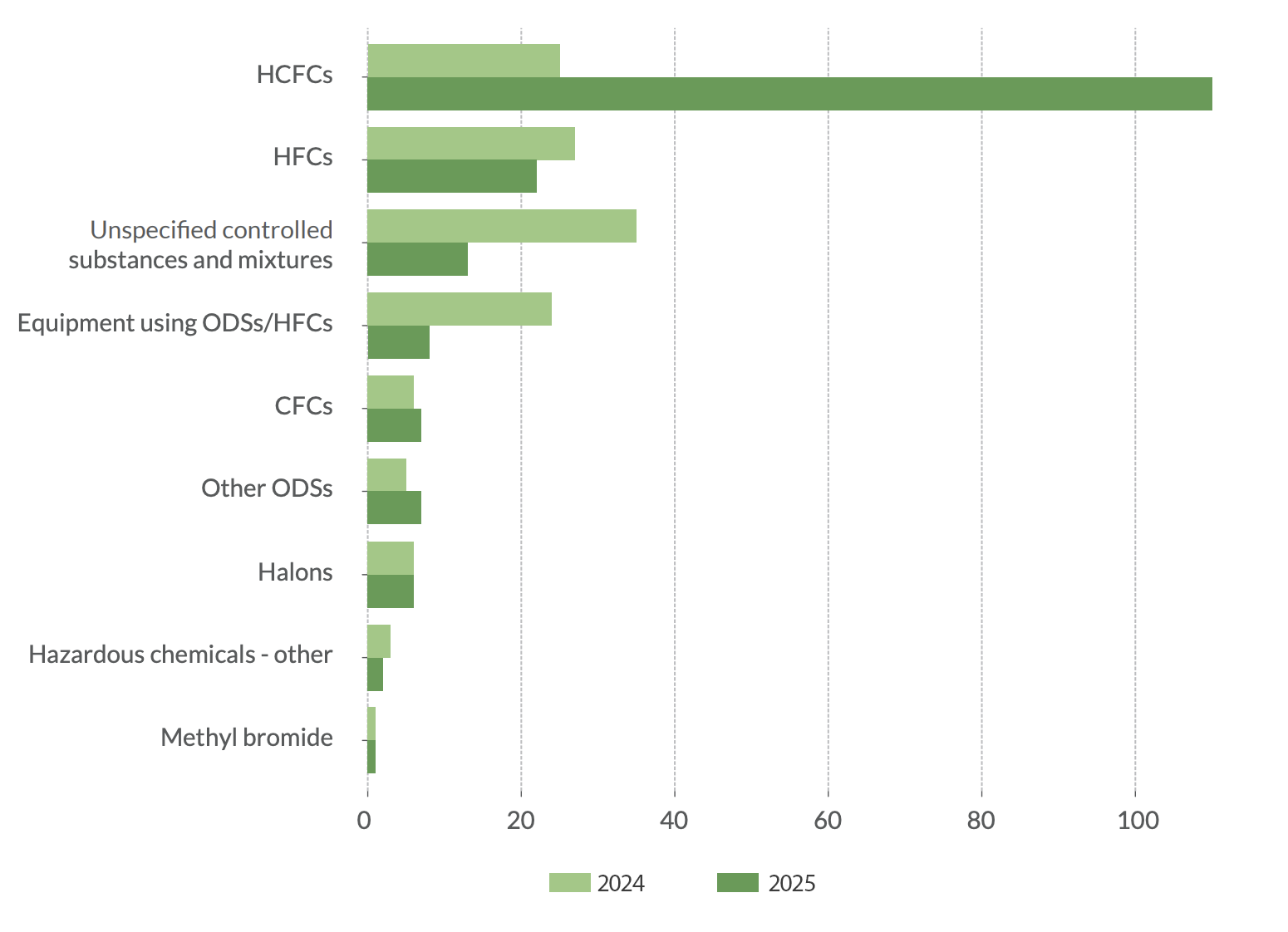
Seizures of substances controlled under the Montreal Protocol in 2024 and 2025, World Customs Organization, Illicit Trade Report 2025.
In 2025, customs administrations reported 185 seizures of smuggled ODS and HFCs, a 26% increase from 2024. HCFCs were the most frequently intercepted substances, with 98 seizures, reflecting a 30% increase from the previous year. Misdeclaration of refrigerant cylinders and concealment of refrigerant in mixed cargo or as part of equipment shipments continue to be modus operandi of refrigerant smugglers. The majority of seizures were made at land borders, with Croatia, Romania, Gambia, Poland, and Bulgaria the top reporters of Montreal Protocol-related cases.
Read more in Issue 5 of EIA’s Illegal Trade Bulletin about the record collaboration between 120 customs administrations that resulted in 409 seizures, including 168 tonnes of ODS and HFCs, highlighted in this report.
Enforcement Crackdown in South Korea
Preventing the illegal release of super pollutants is not limited to combating illegal trade. It also involves enforcement against intentional refrigerant venting during refrigeration and air conditioning (RAC) equipment disposal. Over the course of two weeks, from September 7-18, 2026, the Gyeonggi Province Special Judicial Police Unit is doing just that, conducting a targeted crackdown on 150 scrap dealers across the South Korean province to prevent the release of HFCs into the atmosphere during the illegal collection and dismantling of waste home appliances like refrigerators and air conditioners. The enforcement action also targets abandoned waste and illegal dumping. Without proper recovery and handling at the end of RAC equipment life, the refrigerant will leak directly into the atmosphere, contributing to global warming and/or ozone layer depletion. While individual residential appliances contain relatively small refrigerant charges, compared to commercial or industrial equipment, the improper collection, transportation, storage, and dismantling of refrigerant-containing equipment quickly results in significant emissions.
40 Years and Beyond of the Montreal Protocol
World Ozone Day may arrive once a year, but the life-saving protections of the ozone layer endure year-round, provided the threats to its recovery are addressed. The enormous impact of global cooperation under the Montreal Protocol to protect the ozone layer, so that it may continue to protect us, deserves celebration, along with strong action to ensure its successful implementation is not thwarted by illegal trade and emissions of harmful substances.
Decades of implementation have given us valuable lessons, while innovative approaches are improving our ability to monitor and expose the illegal trade in refrigerants. The urgency has never been greater to collectively apply this knowledge in order to keep the ozone layer on its path to recovery and sharply reduce climate impacts through successful implementation of the Kigali Amendment.
Send us a tip
If you suspect illegal activity related to refrigerants, you may share information with EIA by filling out our anonymous form or emailing us confidentially at [email protected].
Report violations to the EPA
Possible violation of environmental laws or regulations may also be reported to the U.S. Environmental Protection Agency (EPA) here. Information about activities that pose an urgent safety or security threat should be immediately disclosed to relevant authorities.