
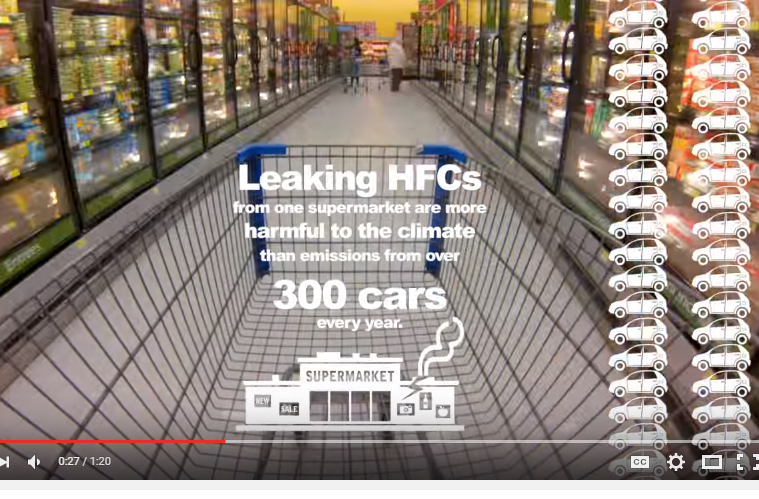
Supermarkets, HFCs, and Global Warming
Learn More on HFCs: External Resources
• An exhaustive report by Michael Kauffield for EIA, May 2012, on the availability and potential of low-GWP alternatives to HFCs across various applications and sectors; calls on POM prohibitions of HFCs as most effective means to drive the phase-out.
• Here is a review of EIA’s European supermarket campaign to introduce the widespread use of low-GWP refrigeration alternatives.
• This EPA Factsheet from October 2010 provides information on existing and potential low-Global Warming Potential (GWP) alternatives in newly manufactured commercial refrigeration equipment: “Transitioning to Low-GWP Alternatives in Commercial Refrigeration”
• You can access the U.S. EPA Fact Sheets on Low-GWP Alternatives here
• May 2012 Progress Report of the Technology and Economic Assessment Panel, UNEP containing progress reports from various technical options committees, including two chapters reflecting the work of the Refrigeration TOC on advances for non-ODS and low-GWP alternatives.
• Additional information on Alternatives to Ozone Depleting Substances by the Technology and Economic Assessment Panel containing more detailed analysis of possible alternatives to HCFCs in refrigeration, air conditioning, foams, fire suppressants, etc. UNEP, 2012.
• Survey of alternative to HFC refrigerants by sector, including numerous case studies by Janos Mate, Claudette Papathanasopoulos, and Sultan Latif, “Cool Technologies: Working Without HFCs,” Greenpeace, 2012.
• Detailed technical overview of the existing and likely low-GWP replacements for ODS and high-GWP refrigerants in numerous refrigeration and air-conditioning applications by Lambert Kuijpers, “2010 Report of the Refrigeration, Air Conditioning and Heat Pumps Technical Options Committee,” UNEP, February 2011.
• “The Use of Alternatives to Synthetic Greenhouse Gases in Industries Regulated by the Montreal Protocol,” the Australian Greenhouse Office, September 2003 is a study undertaken to provide the Australian government with a sound understanding of the status of HFC use in five key sectors and the future prospects for transition to alternatives to synthetic greenhouse gases. It summarizes the view of Australian industry on the commercial availability, technical/cost effectiveness, and overall viability of alternatives.
• “Refrigeration Road Map,” by Carbon Trust with the Institute of Refrigeration from March 2010 introduces energy saving opportunities for refrigeration use in the retail sector and demonstrates how simple actions save energy use, cut costs and increase profit margins. Also discusses low-GWP alternative to current refrigerants.
• An overview of main refrigerants by application with possible alternatives and an exploration of relevant technical details, legislation, standards, and barriers to adoption. By Torben Funder-Kristensen, “Components for Clima Friendly Refrigeration”
• Overview of typical refrigeration equipment, refrigeration systems, possible low-GWP alternatives, and barriers to use. By David Calabrese, “The Future of Refrigerants for Commercial Refrigeration Application,” AHRI
• Overview of high-GWP refrigeration equipment, systems, and technologies and an exploration of alternatives and barriers to use. By Denis Clodic, “Technologies – Equipment/System Manufacturing and Contracting”
• Overview of current compressor and condensing technology, possible low-GWP alternatives, and barriers to use. By Walid Chakroun, “Technologies – Compressors and Condensing Units,” ASHRAE.
• Overview of existing European F-Gas regulations and possible future policy changes. By Arno Kaschl, “EU actions targeting HFC emissions from commercial refrigeration,” European Commission.
• Overview of emissions achievements in the refrigeration sector through public-private partnerships such as GreenChill. By Cindy Newberg, “Addressing Emissions: The Role of Public-Private Partnerships,” US EPA.
What are natural refrigerants and how can they be used?
• “Natural Refrigerants: The Solutions,” a factsheet explaining the available natural alternatives to HFCs by Greenpeace, 2008.
• This “Guidelines for the safe use of hydrocarbon refrigerants: A handbook for engineers, technicians, trainers and policy-makers for a climate-friendly cooling,” by GTZ Proklima, 2010, covers organizational, regulatory, and technical aspects of hydrocarbon refrigeration, including safety infrastructure, quality systems for safety, training, production and manufacturing facilities, equipment design and development, working on systems and equipment, and case studies.
• “New, Natural, and Alternative Refrigerants,” by Star Refrigeration Limited examines numerous alternative refrigeration techniques, concluding that except for some uses of absorption cooling, they are unlikely to find significant acceptance. The market for halocarbon and ammonia refrigeration will continue to grow, but each faces limitations. CO2 is reemerging and its use will grow rapidly in the future.
• “ASHRAE Position Document on Natural Refrigerants,” ASHRAE, January 2009 (reaffirmed 2011, expires 2014). Driven by international agreements, there is a renewed interest in the use of natural refrigerants. ASHRAE supports research, assessment, and growth in the use of these. AHRAE and its members will promote the developments of systems that use natural refrigerants safely and efficiently.
• This 2010 ASGRAE Position paper discusses history, uses, and benefits of ammonia as a refrigerant. It promotes continued use and research, education and training, and up to date policies and regulations.
• Guidance on Natural Refrigerants by Proklima, GIZ, 2008 to policy makers in developing countries on ozone and climate friendly alternatives to fluorinated refrigerants currently on the market.
• This technical paper by Alex Gooseff and Jamie Horton, “Ammonia as the Sustainable Refrigerant: An Ammonia-Halocarbon Comparison,” presented to 2008 IIAR Ammonia Refrigeration Conference & Exhibition, offers case studies on installation costs and energy savings to explore when distribution facilities should consider installing ammonia versus halocarbon split circuit systems. It suggests under 50,000 sq. ft., halocarbon systems are a better fit, while ammonia systems perform better past 200,000 sq. ft., with both systems have comparable performance between.
• This presentation by Andrey Andrusenko, Michael Bellstedt, and Ananth Arkal “Ammonia and CO2 Combined Package Systems for Commercial and Industrial Applications,” presentation to the 9th IIR Gustav Lorentzen Conference, April 2010 covers technical, installation, equipment, safety, and cost aspects of ammonia and CO2 combined package systems along with case studies.
• “Carbon Dioxide In North American Supermarkets,” a 2009 report in ASHRAE Journal discusses basic operation of CO2 secondary coolant systems and reviews effects of heat gain on distribution piping networks. Analysis demonstrates that low-temp CO2 systems, both secondary and direct expansion, operate more efficiently than traditional systems. It concludes with TEWI analysis of systems.