Mining Expansion and the Erosion of Rhino Conservation and Community Rights
Today, southern Africa represents the last significant stronghold for both white and black rhinos, yet mining for coal and critical minerals in South Africa, Namibia, and Zimbabwe threatens to erode decades of conservation progress and undermine the rights of Indigenous and local communities who share and steward these landscapes. While governments publicly pledge to safeguard their endangered rhino populations, they simultaneously continue to approve mining projects that directly threaten critical rhino habitat. This contradiction between conservation rhetoric and approved mining concessions raises serious questions about these nations’ commitment to rhino protection.
Africa’s rhinos face multiple existential threats including relentless poaching and accelerating habitat loss. The continent’s rapidly expanding mining industry and continued demand for coal has become an alarming new stressor on these vulnerable populations.
Africa is at the center of a rapid expansion in mineral extraction, driven by growing global demand for critical minerals and the continent’s vast untapped reserves. The continent hosts approximately 30% of the world’s mineral reserves, yet a disproportionately low percentage of global mineral exploitation has occurred there. This untapped potential is fueling rapid growth in mining production, specifically as the renewable energy sector accelerates demand for critical minerals such as copper, lithium, nickel, cobalt, and rare earth elements. This growth is a major reason for the fragmentation of critical habitats and encroachment on fragile and previously untouched ecosystems that support some of the world’s most endangered megafauna species such as rhinos. It is also displacing local communities and disrupting traditional land use. Many of the minerals fueling these developments are extracted in Africa and exported for processing and consumption abroad, linking environmental harm in rhino range states to decisions and demand originating in other parts of the world and creating a global chain of actors whose accountability extends far beyond the site of extraction.
The direct impacts of industrial mining on rhinoceroses are significant and wide-ranging. Mining activities in all phases disrupt rhino habitats through noise pollution and habitat destruction and fragmentation. Historical examples indicate that noise from drilling, blasting, and even the movement of heavy vehicles alter rhino behavioral ecology and force them to leave otherwise suitable habitat. In Zimbabwe, satellite data analysis conducted in the Midlands Black Rhino Conservancy revealed that bare land expanded by over 160% and woodlands decreased by 46% between 2000 and 2020 in part due to mining activities. The elimination of vegetation during mining cycles limits the availability of food and pushes rhinos to smaller, isolated areas. Local communities dependent on these same ecosystems can be forced to relocate often without any form of compensation or state support, leading to profound disruptions of their traditional livelihoods, cultural heritage, and fundamental human rights. Mining also introduces a bevy of environmental pollutants such as heavy metals, which can contaminate water and soil systems, disrupting entire ecosystems, and pose significant risks for surrounding communities. In addition, road construction to facilitate mining can indirectly increase poaching intensity as such roads act as access routes between settlements and previously inaccessible rhino habitats.
The following three case studies across Southern Africa reveal the direct conflict between mining expansion and rhino preservation efforts. These examples from South Africa, Namibia, and Zimbabwe underscore the severity and widespread nature of this problem by demonstrating how mining interests are encroaching on critical rhino habitat while communities are actively resisting these developments.
Coal Mining Threatens Rhinos in Hluhluwe-iMfolozi Park in South Africa
Hluhluwe-iMfolozi Park, a prominent protected area in KwaZulu-Natal, South Africa, which provides critical habitat for white and black rhinos and is in the throes of a poaching crisis, has become increasingly encircled by fossil fuel company concessions that seek to tap into the area’s substantial coal deposits. The threats posed by the nearby coal mining materialized in December 2021 when the Black Umfolozi River, which runs through the park, became heavily polluted with 1.5 million liters of toxic mining waste following a coal slurry dam failure at the Zululand Anthracite Colliery. According to the Daily Maverick, more than 12 extractive corporate entities have filed for mining or exploration rights in areas adjacent to this sanctuary. These entities are primarily national South African companies whose common aim is the extraction of coal. Hluhluwe-iMfolozi Park is located about 85 kilometers from Richards Bay, home to the Richards Bay Coal Terminal (RBCT), Africa’s largest coal export terminal, which provides a strategic pathway for trucking coal from mines near the park for bulk export to overseas markets like India, Pakistan, and China.
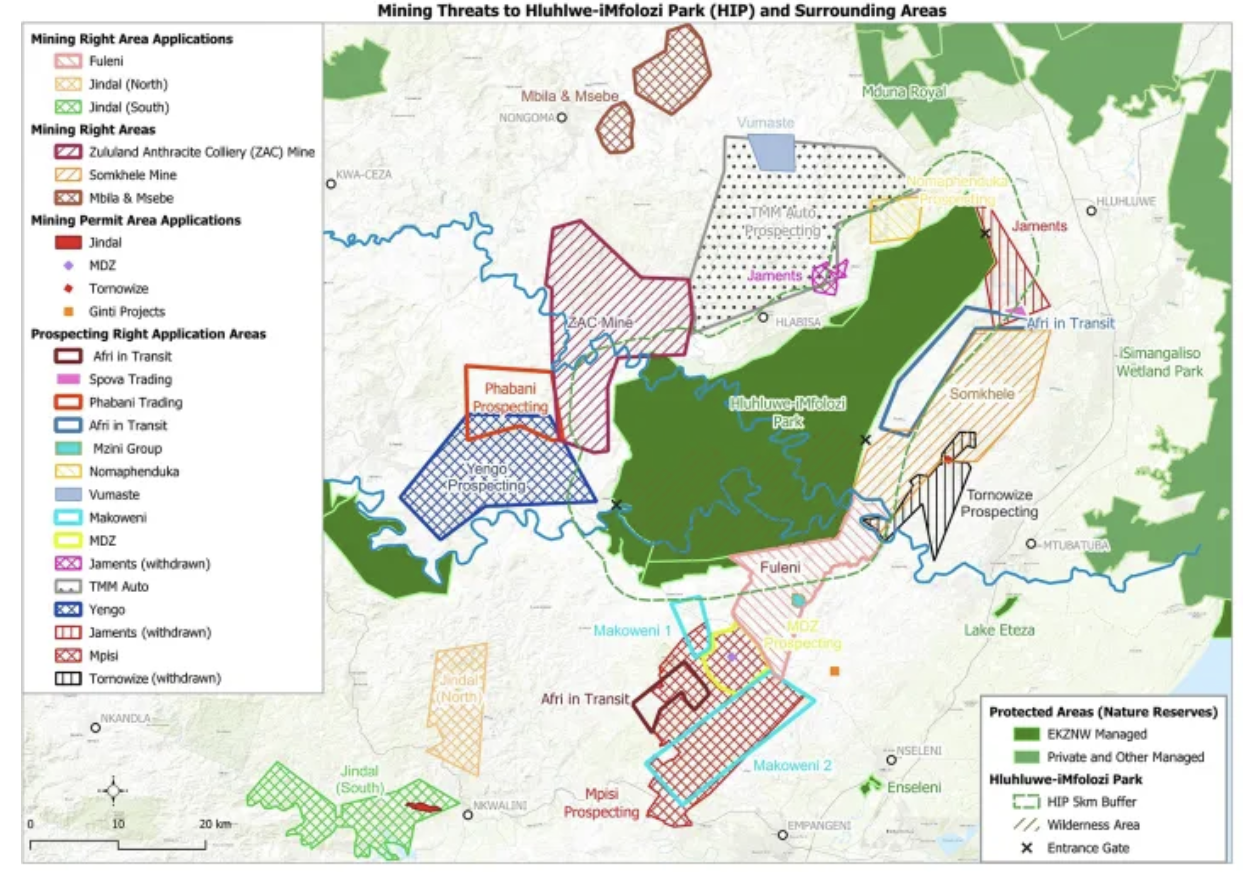
Johannesburg-based Afri In Transit (AIT) group, a mining and logistics company, has submitted the most recent prospecting application covering 7,500 hectares of community lands in the Somkhele area situated right at the boundary of Hluhluwe-iMfolozi Park. This application has faced strong opposition from local communities and environmental groups concerned about the irreversible damage to the environment and their livelihoods. AIT has requested prospecting and mining permissions to explore and extract a range of mineral resources including torbanite, coal, pseudocoal, oil shale, lithium, limestone, iron ore, general heavy minerals, graphite, and fluorspar. Should economically viable mineral deposits be discovered and further mining rights be authorized by the Minister of Mineral and Petroleum Resources, these mining companies “will be free to conduct daily dynamite blasting or strip-mining directly next to Ezemvelo’s flagship Big Five conservation area and tourism attraction.”
Namibia’s Critically Endangered Black Rhinos at Risk from Proposed Tin Mine
In Namibia, open-pit mining is expanding into community-managed conservation areas despite legal protections and joint land governance arrangements. In June 2024, two mining entrepreneurs, Ottilie Ndimulunde and Timoteus Mashuna, were granted environmental compliance certification by the Ministry of Environment, Forestry and Tourism for tin mining on 19,000 hectares of land located within the Doro Joint Management area in the Kunene region. This area is jointly governed by three community conservation organizations: Uibasen Twyfelfontein, Doro !Nawas, and Sorris Sorri, which have formal authority over land use decisions, as well as the nature travel company Ultimate Safaris which operates rhino-based ecotourism and conservation activities through joint venture agreements with the conservancies.
Since August last year, when preliminary road construction commenced, the conservancies have filed multiple urgent legal injunction applications. In December 2024, the High Court Main Division in Windhoek granted an interdict prohibiting the mining entities from carrying out any further work on the road or any mining activity until the High Court reviews the injunction applications. The review is expected to take between 12 and 18 months, giving temporary protection to the rhinos. The direct impacts on rhinos from the mining activity that has already taken place has been well-documented through this region. Uibasen conservancy administrator Laurensia //Naobes described the environmental disturbances that are occuring: “There used to be a quiet riverbed where the mining is happening, with different wildlife like antelopes, ostriches, springboks. They moved out because of the human disturbance. We are seeing the black rhinos becoming stressed and starting to move away.”
The situation became more complex in January 2025 when the Namibian Competition Commission issued a directive requiring Ultimate Safaris and the three conservancies to end their tourism agreement within 30 days. This move was a win for Ndimulunde and Mashuna, who claimed that the conservation deal is blocking the tin mining operation from generating employment opportunities. This decision effectively undermined the conservancies’ efforts to manage their land for conservation and sustainable tourism, demonstrating a disregard for local self-determination and established community-led conservation models. In April 2025, however, the Commission granted a 90-day extension to allow for consultations with the Ministry of Environment, leaving the future of the agreement and the authority of Namibia’s conservancies hanging in the balance.
Mining Companies Target Zimbabwe’s Hwange National Park and Its Black Rhinos
In Zimbabwe, the Chinese-owned company Sunny Yi Feng (Pvt.) Ltd. is pursuing a vertically integrated operation that links coal extraction, energy generation, and tile manufacturing. In February 2025, the company submitted an application to mine coal in the Sinamatella area of Hwange National Park, specifically within the Sinamatella Black Rhino Intensive Protection Zone, an area home to a population of Critically Endangered black rhinos. The coal extracted from this site would fuel a 210 MW coal-fired power plant currently under construction in Norton, which is intended to power Sunny Yi Feng’s local tile production. The company exports its finished products primarily to neighboring countries, including South Africa, Mozambique, Botswana, and Malawi. On 6 March 2025, the Zimbabwe Parks and Wildlife Management Authority (ZimParks) issued a public statement opposing the mining application. Spokesperson Tinashe Farawo warned that the project would “increase the risk of species extinction” for the black rhino population in Hwange. ZimParks urged the Ministry of Mines and Mining Development to reject the application and prohibit future mining in protected rhino habitat. As of May 2025, the application remains under review.
Protecting Rhinos Requires Maintaining Intact Healthy Ecosystems
The situations in South Africa, Namibia, and Zimbabwe illustrate how mining expansion is degrading critical rhino habitat, negatively impacting rhino behavior, directly threatening community land rights, and undermining broader conservation and development goals. Even as the global energy transition drives demand for critical minerals, it is imperative to directly challenge and prevent the most damaging forms of extraction. In addition, the approval of coal mining projects in these regions contradicts the commitments many southern African countries have made to transition to renewable energy, including South Africa’s Integrated Resource Plan (2019) and Just Energy Transition Partnership, as well as Zimbabwe’s National Renewable Energy Policy (2019). Mining in and adjacent to these protected areas would have disastrous consequences for rhinos and local communities, and would demonstrate a profound failure of environmental stewardship and legal oversight.
Transparency around both rhino conservation measures and mining rights is extremely lacking across the region. Namibian court documents show that environmental impact assessments frequently fail to mention how human activity could escalate poaching threats or force rhinos to abandon their habitats. A similar situation that highlights comparable procedural shortcomings is the 2020 case of Canadian company ReconAfrica’s activities in Namibia’s Kavango Basin. Despite significant criticisms as regards to the way the environmental impact assessments were carried out, drilling occurred in the watershed that feeds into the Okavango Delta, a UNESCO World Heritage Site (and former rhino habitat, until poaching decimated the Okavango’s rhino population). The project demonstrates the same blatant marginalization of local communities as the three case studies highlighted above. While ReconAfrica reported to have engaged in consultations, approximately 85% of affected residents lack internet access, and thus it is unclear whether these consultations took all local voices into account. ReconaAfrica proceeded with drilling in mid-2024 despite persistent objections from communities and conservation groups, having drilled three stratigraphic test wells in the Kavango Rift Basin and one exploration well in the Damara Fold Belt.
Protecting rhinos requires maintaining intact functioning ecosystems free of industrial disturbance. Southern African nations have the opportunity to uphold their conservation priorities by implementing meaningful regulations on mining in and around rhino habitats. This means not authorizing any mining, drilling, or other extraction within or adjacent to protected areas, establishing and enforcing buffer zones around protected areas, conducting detailed environmental impact assessments, respecting needs and concerns of local and Indigenous communities, and ultimately planning for long term conservation. In addition to the growing threat of mining expansion, comprehensive rhino protection must also address poaching, rhino horn trafficking, and habitat loss and fragmentation – all of which continue to pose existential challenges to the remaining rhino populations.
As mining operations spread across Africa, the survival of the continent’s rhino population is becoming more precarious. Rhino range states can and must do better to protect their rhino populations from the destructive consequences of unchecked resource extraction. Ensuring the long term survival of Africa’s rhinos will require dedication to conservation that places long term ecological health over short term financial gain, while simultaneously addressing the compounding pressures of poaching and habitat destruction that collectively threaten these species.