Illegal Trade Bulletin
Issue 1: Online Sales of Black Market Refrigerants
As the phase-down of hydrofluorocarbons (HFCs) and the phase-out of ozone-depleting hydrochlorofluorocarbons (HCFCs) progress in the U.S. and globally, illegal imports of these super pollutant substances are a serious and growing threat.
Smuggled or counterfeit refrigerants not only break the law, but can pose significant safety risks to technicians, consumers, and equipment.
Staying informed is the first step to preventing illegal trade – learn about a recent smuggling case and red flags to watch for below or click here.

On March 4th, 2024, Michael Hart of San Diego was arrested and charged with smuggling HFCs and HCFCs into the U.S. from Mexico in his vehicle and then selling them for profit, in violation of the American Innovation and Manufacturing (AIM) Act and the Clean Air Act. The maximum penalty is five years in prison and a $250,000 fine.
Court documents reveal that Hart crossed the U.S.- Mexico border repeatedly between July and October 2022 to purchase and then smuggle refrigerants. Hart posted the refrigerants for sale on various online platforms, including OfferUp and Facebook Marketplace. Hart stated that each canister cost approximately $130-$140 USD in Mexico. He claimed that he used some of the canisters himself when he repaired air conditioning units, and that he sold the rest of the canisters to others in the air conditioning industry for approximately $275 per canister – a 100% profit.
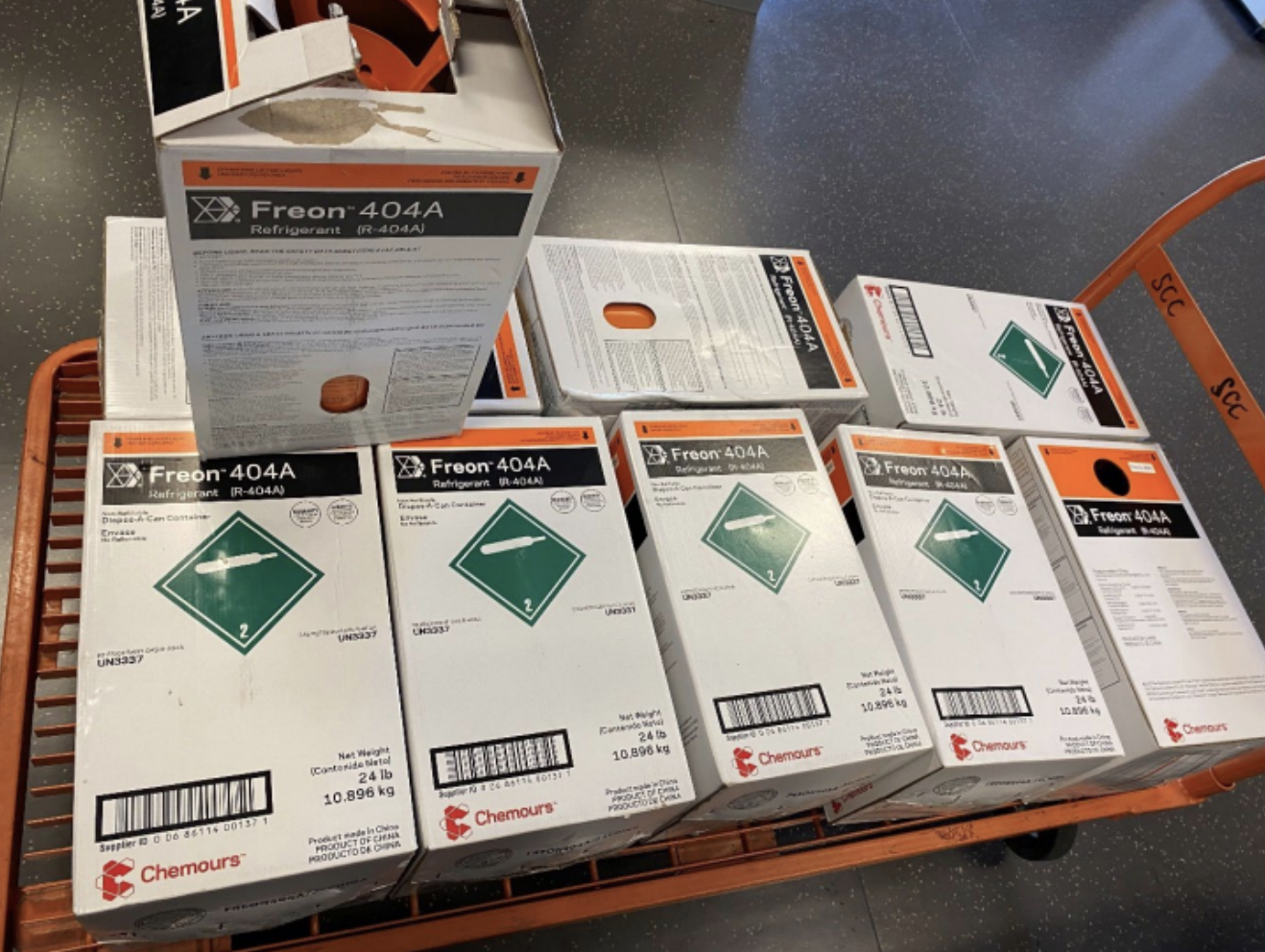
Ten 24-pound canisters found in Hart’s vehicle identified as Freon 404A from China. Source: Sentencing Memorandum, United States v. Hart, docket 3:24-cr-00383..
Hart’s OfferUp records show that he posted various “for sale” listings for refrigerant, and “offered” at least 94 cylinders of refrigerant to 22 individuals from July 16, 2022 to October 14, 2022. The cylinders contained R-22 (51 cylinders), R-410A (10), R-404A (31) and R-134A (2), amounting to 2,840 MT CO2e – or the equivalent of driving 663 gasoline-powered passenger vehicles for one year, per EPA’s GHG calculator – if released into the atmosphere.
On February 3, 2025, Michael Hart was sentenced to time served, one year of supervised release, and ordered to pay a restitution fee, after pleading guilty to conspiring to illegally import HFCs from Mexico and sell them in violation of federal law. He also admitted to conspiring to illegally import HCFC-22, banned under the Clean Air Act.

This case illustrates one way illegal refrigerant trade can manifest: through cross-border smuggling and unauthorized resale on informal online platforms without required EPA allowances or proper certification. Increased awareness and due diligence across the supply chain can help disrupt illegal refrigerant trade and support the enforcement of environmental regulations.
Red Flags to Watch For:
Some refrigerant sales might not meet legal or safety standards. The following red flags could suggest that a refrigerant transaction is potentially unsafe, unauthorized, or may warrant reporting to the authorities.
- Unusual pricing, sales channels, or shipping methods.
- Prices or offers significantly lower than market value.
- Unverifiable or suspicious payment or shipping methods (e.g., cash-only transactions; untraceable or no-return shipments).
- Sales conducted through informal online platforms (e.g., peer-to-peer platforms like OfferUp or Facebook Marketplace, where buyers and sellers arrange price, payment, and pickup directly).
- Product to be transported or made available in an unusual manner (e.g., delivery or hand-off at non-business locations; transported informally without assurance of proper handling, like in personal vehicles).
- Missing or incomplete product documentation.
- Missing certificates of origin, safety data sheets (SDS), or import/export records.
- Inconsistent or vague product labeling or advertising.
- Unmarked cylinders or packaging.

Examples of noncompliant unmarked cylinders unidentifiable without their packaging. Source: UNEP technical brief on Labeling Refrigerant Cylinders.
- Improper packaging, labeling, or cylinder non-compliance.
- Refrigerant not sold in approved Department of Transportation (DOT) cylinders or packaging, cylinder and packaging do not match, or packaging is missing or suspiciously repackaged.
- Non-compliant cylinder labeling (lacking product identifier like CAS number, hazard pictograms or signals, manufacturer/importer identity, DOT markings).
- Incorrect or fake labels on cylinder or packaging.
- Lack of proper documentation or certification.
- Seller does not verify that buyer is either 1) a certified Section 608 or Section 609 technician, or 2) employs a certified technician, or does not request a statement of intent to resale from buyer. Exceptions and details are available here.
- Seller cannot provide proof of EPA refrigerant sales authorization or import allowances for controlled HFC- or HCFC-based refrigerants.
- Suspicious sourcing or supply chain.
- No verifiable business address or website.
- Refusal to share documentation or supplier details.
- Refrigerant origin unknown or cannot be authenticated.
Send us a tip
If you suspect illegal activity related to refrigerants, you may share information with EIA by filling out our anonymous form or emailing us confidentially at [email protected].
Report violations to the EPA
Possible violation of environmental laws or regulations may also be reported to the U.S. Environmental Protection Agency (EPA) here. Information about activities that pose an urgent safety or security threat should be immediately disclosed to relevant authorities.