

South African Court Ruling on Rhino Horn Exports Sets Off Alarm Bells
Last month, news broke in South Africa about a court ruling that shocked and alarmed the rhino conservation community: The ruling appeared to allow private citizens to export rhino horns using an obscure exemption to international trade rules. The ruling of the High Court in Northern Cape province was totally unexpected and could result in severe harm to rhino populations not only in South Africa, but across Africa and Asia. The government has appealed the ruling, though the final outcome is anything but certain.
The debate over whether to engage in commercial trade in rhino horn is one of the most polarizing and emotionally charged issues associated with rhino conservation. Proponents of trade claim that demand reduction is futile and that legal trade will replace illegal trade by providing an alternative source to horn from poached rhinos. EIA firmly rejects this inherently flawed line of reasoning. As past attempts to trade rhino horn have shown, legal trade will only stimulate demand and further endanger rhino populations globally by fueling poaching and undermining years of demand reduction and consumer behavior change progress.
The major threat rhino horn trade poses to the survival of wild rhinos led world governments to ban the international trade in 1977, though it would take another 15 years before legal domestic markets for rhino horn in consumer countries were finally shut down. Once domestic rhino horn trade prohibitions were in place to implement the international ban, the rampant poaching of African rhinos finally ceased, allowing rhino populations to begin recovering.
The ban was enacted by listing all rhino species on Appendix I of the Convention on International Trade in Endangered Species of Wild Fauna and Flora (CITES). Under CITES, it is prohibited to trade any species, or their parts and products, internationally for commercial purposes that are listed on Appendix I.
On the other hand, species listed on Appendix II can be traded commercially with the proper permits. Before a government can issue an export permit, it must conduct due diligence by ensuring that the specimen being traded was legally acquired (a legal acquisition finding, or LAF) and that the trade will not be detrimental to the survival of the species in the wild (a non-detriment finding, or NDF). South Africa’s population of white rhinos are technically listed on Appendix II, but with an annotation limiting trade to live animals and hunting trophies – so rhino horns are regulated under Appendix I rules, i.e., no commercial trade.
There have been no fewer than 10 attempts to overturn the ban on rhino horn trade from countries hoping to profit off commercial exports while downplaying the very real risks that unleashing trade would have on wild rhino populations (including at the 20th CITES Conference of the Parties currently under way in Samarkand, Uzbekistan). Thankfully, so far, the international community has rejected all proposals to amend the CITES appendix listings for rhinos to allow for international rhino horn trade.
Here’s where the exemption at the center of the South African lawsuit comes into play
According to Article VII of the CITES convention, if an Appendix-I species is “bred in captivity not for commercial purposes”, exports can be authorized with a certificate instead of an export permit. A captive breeding certificate does not require the same preconditions that are at the heart of the treaty’s protections, effectively allowing the exporter to circumvent the CITES rules for species listed on Appendix I or Appendix II.
For years, private rhino owners in South Africa have tried to exploit this exemption. The South African government has rejected all such applications to date. Unfortunately, this rejection spurred one private rhino owner to mount a legal challenge against the government.
In 2023, Hendrick Diedericks filed a lawsuit attempting to compel the government to issue captive breeding certificates under the CITES Article VII(5) exemption so that he could export rhino horn commercially after his applications for export using captive breeding certificates were repeatedly denied. According to court documents reviewed by EIA, Diedericks sought permission to export rhino horn to Laos, China, Vietnam, Japan, Mongolia, Canada, and the US.
The rhino horn was obtained from white rhinos born on his game reserve, Rockwood, in Northern Cape. Rockwood is a registered Captive Breeding Operation under South African law, but that does not necessarily mean the rhinos meet the CITES definition of ‘bred in captivity,’ or does not meet the CITES definition of ‘bred in captivity for commercial purposes’ – critical distinctions when attempting to apply the exemption.
The government of South Africa refused to authorize the rhino horn exports because South Africa does not actually implement the exemption – more on that below.
A deeply flawed judgement from the Northern Cape High Court
In Court, the government submitted that South Africa does not apply the exception that allows exports pursuant to a certificate instead of an export permit. As a result, South Africa’s implementing legislation is stricter than what the treaty requires: measures to apply Article VII(5) are not included in South Africa’s domestic CITES implementing regulations. Having domestic legislation that is stricter than an international treaty is common practice, and many countries do not give effect many of the exceptions provided for in the treaty. In fact, the text of CITES itself acknowledges that adopting stricter legislation is a right of Parties.
However, the Northern Cape High Court judges presiding over the case ultimately ruled in favor of Diedericks and gave the provincial government one week to issue the captive breeding certificates or provide justification as to why the permits would not be issued.
The judges based their ruling on three points: 1) South Africa did not explicitly notify the CITES Secretariat about its stricter domestic measures and therefore they cannot be applied; 2) because South Africa directly incorporated CITES into its domestic laws it must implement Article VII(5) – even though there is no mention of it in South Africa’s domestic legislation; and 3) the rhinos on Diedericks’s property were bred for conservation purposes and not commercial purposes.
The first two points appear to represent a fundamental misunderstanding of international law in general and CITES in particular. There is no requirement enshrined in the CITES convention text that compels a Party to notify the Secretariat of stricter domestic measures. A Party can certainly choose to do so voluntarily, but even if it does not, the stricter domestic measure still applies as part of the country’s national legislation. Moreover, according to past correspondence between the CITES Secretariat and the South African government that was reproduced in the judges’ ruling, the Secretariat was aware that South Africa does not implement Article VII(5).
As for the third point, the judge reasoned that although Diedericks wants to export the rhino horn for commercial purposes, he “does not seek to make a commercial profit out of this trade in white rhino horn” because “[t]he proceeds of such sales will be ploughed back into conservation of the rhino.” There is nothing, however, to guarantee that proceeds from sales will be put toward conservation, and the very definition of what constitutes legitimate rhino conservation is contested in the conservation community.
While Rockwood is a registered Captive Breeding Operation under South Africa’s National Environmental Management Biodiversity Act (NEMBA), this does not automatically mean that Rockwood’s rhinos meet the CITES definition of ‘bred in captivity’, and it is far from clear whether the rhinos were bred for commercial purposes.
According to CITES Resolution Conf. 12.10, ‘bred for commercial purposes’ refers to “any specimen of an animal bred to obtain economic benefit, whether in cash or otherwise, where the purpose is directed toward sale, exchange or provision of a service or any other form of economic use or benefit.”
There are several factors to consider when attempting to determine whether this definition applies to Rockwood’s rhinos. First, Rockwood allows trophy hunting of its white rhinos. Given that such trophy hunts are not offered free of charge, it could be argued that breeding rhinos for hunting would be breeding the animals for economic benefit and/or the provision of a service.
Secondly, Rockwood stockpiles rhino horn that has been obtained from dehorning procedures. Dehorning, in which a rhino is tranquilized and its horn sawed off above the growth plate, has become a widespread practice in South Africa to ostensibly deter poachers from targeting rhinos that retain small amounts of horn. The removed horn can then be registered and stockpiled, or destroyed. The only reason to keep a rhino horn stockpile is to eventually try to sell the horn. Maintaining a rhino horn stockpile incurs expensive security costs and presents a constant risk of theft. Last year alone, at least 712 rhino horns were stolen from stockpiles in South Africa – underscoring the massive enforcement challenge and potential contribution to the international illegal rhino horn trade that they present.
Whether breeding rhinos for trophy hunting and stockpiling rhino horn is for commercial purposes in the context of CITES is ultimately a decision for the CITES Management Authority of South Africa and the CITES Standing Committee. It is anything but obvious.
What would it mean if privately owned rhinos in South Africa are considered to be “bred in captivity”?
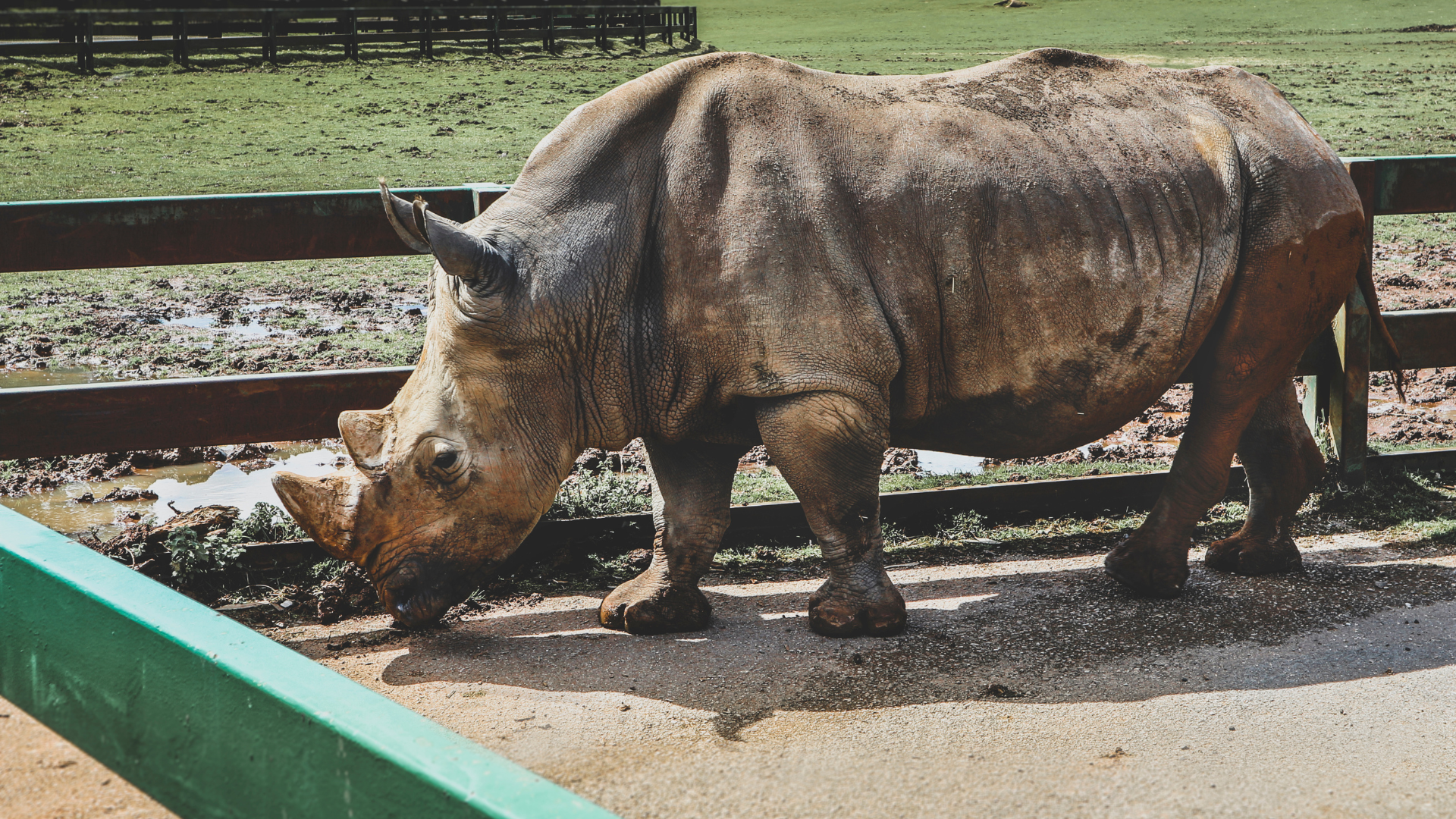
Private rhino owners play a critical role in rhino conservation. In South Africa they are responsible for more than 50 percent of all white rhinos found in the country due to the slaughter of rhinos in protected areas that have left populations severely depleted in places like Kruger National Park. Like Rockwood, many other private rhino reserves are registered as captive breeding operations under NEMBA. Right now, their rhinos are all considered part of the wild white rhino population by the IUCN SSC African Rhino Specialist Group, which is the leading international authority on African rhinos with a mission to “promote the development and long-term maintenance of viable populations of the various sub-species of African rhinos in the wild.” (emphasis added)
The IUCN African Rhino Specialist Group is also responsible for assessing the population status of white and black rhinos to inform conservation efforts. IUCN population assessments are the global standard used to determine whether and to what degree a species is threatened with extinction, and the official IUCN population estimates inform both domestic and international policy decision-making, including at CITES.
The IUCN currently classifies the southern white rhino as Near Threatened with a total population of 15,750 as of the end of 2024. South Africa accounted for 12,082, or 76 percent, of the continental white rhino population. If even half of South Africa’s rhinos are suddenly considered captive and no longer wild, that would reduce the total “wild” population estimate by more than 40 percent – which would have major implications for the conservation status of the southern white rhino.
At the same time, classifying privately-owned rhinos as captive bred and eligible for the Article VII(5) exemption could incentivize private rhino owners to “speed breed” their rhinos to obtain as much rhino horn as possible. This would require intensively managing rhinos which could not fulfill their natural ecological role in their native grassland ecosystems – they would effectively be treated like cattle with horns sticking out of the front of their face instead of the sides of their head. Is this truly what private rhino owners, who aim to support rhino conservation efforts, really want?
It is certainly not what the Government of South Africa wants. In March 2024, the Department of Forestry, Fisheries and the Environment published its Policy Position on the Conservation and Sustainable Use of Elephant, Lion, Leopard and Rhinoceros. The Policy Position called explicitly to “Phase out intensive management and captive breeding of rhinoceroses for commercial purposes, and enhance wild populations.”
Even if the High Court ruling holds, it is unclear what country – if any – would accept rhino horn from South Africa. Rhino horn possession, trade, and use is illegal in the countries that have historically accounted for most demand (e.g., China and Vietnam), and these very same countries have dedicated a huge number of resources to improving legislation, strengthening enforcement, and supporting demand reduction and consumer behavior change initiatives
And it’s working. Vietnam is no longer a safe haven for rhino horn traffickers, who are now regularly prosecuted and convicted with significant penalties. In China, the number of seizures implicating the country has declined significantly in recent years following several successful enforcement operations that have dismantled entire rhino horn trafficking networks. Why would these countries want to risk undoing all this progress?
These are just some of the thorny issues that could be unleashed if the Article VII(5) Pandora’s Box is opened for rhino horn trade.
What comes next
After the Northern Cape High Court ruling, the South African government announced its intention to appeal the decision. The case will now move to the Supreme Court of Appeal in Bloemfontein, and if one of the parties to the case appeals its decision, the case will move to the Constitutional Court for a final judgment.
This expected process is all tentative, however. Shortly after the government expressed its intent to appeal, the President of South Africa fired the Minister of Environment. The decision to do so came at the behest of the leader of South Africa’s Democratic Alliance political party and has been mired in controversy and rumors of undue influence by those with wildlife industry connections. An ally to the wildlife ranching industry – and pro-rhino horn trade lobby – is expected to take over the role. If that happens, there is a risk that he withdraws the national government’s appeal. The situation is incredibly fluid and uncertain.
EIA will be closely following developments on this case and supporting local stakeholders working to push back on the High Court ruling and fighting against opening the floodgates to rhino horn trade.
Rhinos around the world are facing a litany of threats, from habitat loss and climate change to poaching and organized rhino horn trafficking. At the same time, some rhino range states are making progress to restore rhino populations through translocations and reintroductions to new habitat, and have experienced a downturn in poaching.
It has been slow and arduous, but the rhino conservation community is making progress. Allowing international rhino horn trade would render it all for naught.