Resources — EIA

Resources

None
Report

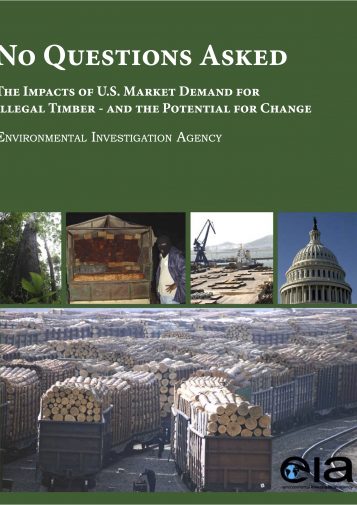
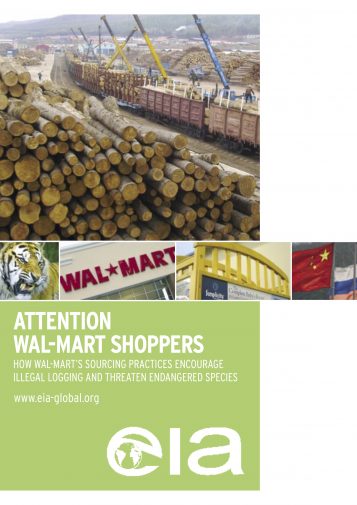
Attention Wal-Mart Shoppers: How Wal-Mart’s Sourcing Practices Encourage Illegal Logging

Despite Wal-Mart’s newfound corporate emphasis on sustainability, undercover investigations in China by the Environmental Investigation Agency (EIA) have found that Wal-Mart is turning a blind eye to illegal timber sources in it’s supply chain which threaten some of the world’s last great natural forests. Wal-Mart’s no questions asked’ sourcing policy is having particularly dangerous consequences […]

Report

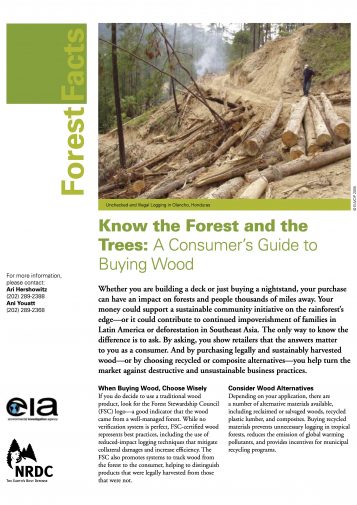
Know the Forest and the Trees: A Consumer’s Guide to Buying Wood

Whether you are building a deck or just buying a nightstand, your purchase can have an impact on forests and people thousands of miles away. Your money could support a sustainable community initiative on the rainforest’s edge—or it could contribute to continued impoverishment of families in Latin America or deforestation in Southeast Asia. The only […]

None
Report

Wal-Mart’s Sustainability Initiative: A Civil Society Critique

Nearly two years ago, Wal-Mart CEO H. Lee Scott announced a bold initiative to turn the world’s largest company green. A long-anticipated first progress report on these sustainability goals is expected to be released soon. In advance of the company’s report, 23 environmental, farm, labor, and other civil society groups have offered their own critiques […]

Illegal logging in the Russian Far East is of particular concern because the forests are home to the last 450 wild Siberian tigers. The Lumber Liquidators case was investigated jointly by the U.S. Fish & Wildlife Service and Homeland Security Investigations and prosecuted by the Department of Justice under the name “Operation Oakenshield.”
Video

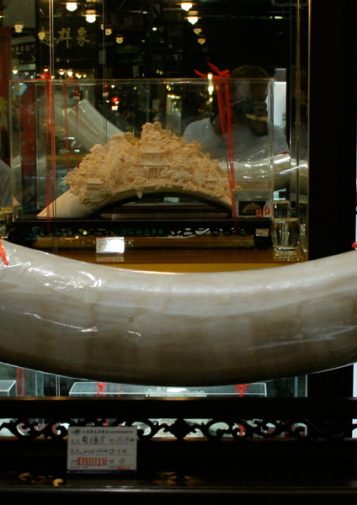
Made in China

EIA’s investigators went undercover to expose China’s illegal ivory trade. This video presents key evidence in the struggle to protect a beloved endangered species: the African Elephant.

Report

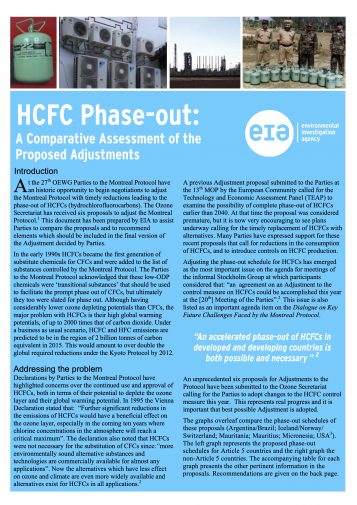
HCFC Phase-out: A Comparative Assessment of the Proposed Adjustments

In the early 1990s HCFCs became the first generation of substitute chemicals for CFCs and were added to the list of substances controlled by the Montreal Protocol. The Parties to the Montreal Protocol acknowledged that these low-ODP chemicals were ‘transitional substances’ that should be used to facilitate the prompt phase out of CFCs, but ultimately […]