New evidence of widespread illegal gold mining in Munduruku Indigenous territory in the Brazilian Amazon as international human rights court investigates
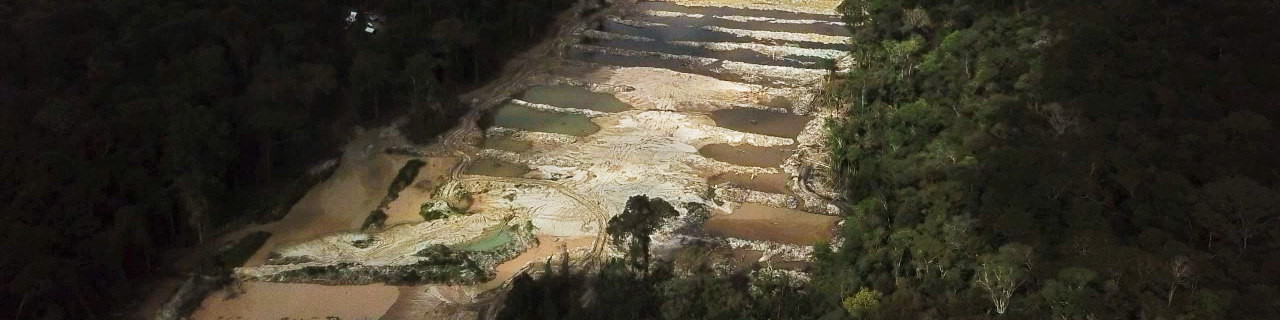
WASHINGTON, D.C. – A new EIA report presents high-resolution satellite imagery showing extensive illegal gold mining across Munduruku Indigenous territory in the Brazilian Amazon despite a recent government crackdown. The report shows how Munduruku organizations, with support from EIA, are using geospatial monitoring technologies to document and report on illegal mining in their territories, which is contaminating their water and food supplies with toxic mercury. The evidence is being shared with Brazilian authorities and the Inter-American Court of Human Rights (IACHR), which sent a delegation in early September to assess Brazil’s compliance with its commitments to protect Indigenous rights and livelihoods.
“Illegal gold mining continues to poison Munduruku lands and people, contaminating our food and water with toxic mercury. By allowing this mining to continue, the Brazilian government is failing to live up to its Constitutional and international commitments to protect our rights and well-being,” stated the Wakoborũn Munduruku Women’s Association.
The new evidence is the latest from a series of monitoring reports jointly produced by three Munduruku organizations and EIA and shared with government and international oversight bodies. The reports use high-resolution satellite imagery and field observations to document the continued destruction of forests and waterways by illegal gold mining in Munduruku territories in the upper Tapajós region. Between November 2024 and January 2025, Brazil’s federal government carried out a much-publicized enforcement operation to halt the mining, but monitoring by the Munduruku and EIA found that it quickly resumed and has accelerated this year. Despite evidence being routinely shared with relevant government agencies, EIA is not aware of any further action being taken to halt the mining.
“The scale and brazenness of illegal gold mining in Munduruku territory is astonishing, and the impacts for the Munduruku people truly devastating,” said Rick Jacobsen, Senior Manager at EIA US. “Rivers are being replaced with toxic pools of mercury and forests mowed down for illegal mining sites, roads and airstrips. The government should be applauded for its efforts to stop the mining last year, but the battle is far from over and strong action is urgently needed to stop this health and environmental crises.”
The Munduruku people, numbering approximately 16,000, have lived for centuries along the Tapajós River and its tributaries in what is now Pará and Mato Grosso. Their territories lie on the frontlines of deforestation in the Brazilian Amazon and face many threats. Earlier this year, EIA published Bootleggers, Brokers and Buyers, exposing an extensive illegal logging operation in the Munduruku Indigenous Territory that degraded thousands of hectares of pristine rainforest. The Munduruku and EIA submitted the evidence to the Brazilian government, but to date no one has been held accountable for this massive timber theft.
The Munduruku are calling on the government to take immediate action to halt illegal mining, remove all invaders from their territories and establish a permanent presence to deter future invasions.
Contact
Rick Jacobsen, Senior Manager, Commodities Policy, EIA US – [email protected]
Holly Koch, Communications and Media Lead, EIA US – [email protected]