Illegal Trade Bulletin: Issue 9
Smuggled Refrigerants and International Enforcement Ahead of Global Treaty Meeting
The 9th issue of EIA’s Illegal Trade Bulletin highlights illegal trade cases reported by countries ahead of the upcoming Montreal Protocol meeting in Bangkok, several recent enforcement successes in Europe, and the importance of international cooperation for effective enforcement.
Illegal Trade Cases Reported by Parties Ahead of OEWG48
Ahead of the upcoming 48th meeting of the Open-Ended Working Group (OEWG48) of the Parties to the Montreal Protocol, taking place in Bangkok, Thailand from July 13-17, 2026, countries are encouraged to submit updates on illegal trade cases. Available through the United Nations Environmental Programme (UNEP) Ozone Secretariat’s database, this information supports the exchange of intelligence on illegal trade methods and enforcement responses. A synthesis of reported cases and best practices is scheduled for discussion at OEWG48.
As highlighted in Issue 3 of this bulletin, the need for greater enforcement capacity and international cooperation is a recurring insight from dedicated discussions on strengthening Montreal Protocol and Kigali Amendment implementation. Since April 22, 2025, countries have reported more than 320 cases across 18 countries through the voluntary reporting system, representing more than 751,222 kilograms of controlled substances.
To showcase one example, the U.S. reports a case involving the attempted import of 4,480 kilograms of HFC-23 from China. Authorities denied entry on April 24, 2025 after determining that the importer did not hold the required import allowances under the American Innovation and Manufacturing (AIM) Act. The investigation is ongoing. If released into the atmosphere, this shipment of HFC-23 would result in emissions equivalent to 55,552 metric tons of CO2, the same emissions produced from burning almost 62 million pounds of coal. While preventing the entry of this super pollutant into the domestic market represents a significant enforcement success, denial of entry alone does not fully eliminate the potential environmental damage. Without adequate follow-up controls and international coordination, returned shipments may re-enter illegal trade channels or be vented into the atmosphere rather than properly managed.
EIA has previously published detailed recommendations on ways to strengthen implementation of the Montreal Protocol, including for combatting illegal trade. EIA will be attending OEWG48 and will continue to closely monitor discussions on illegal trade methods, enforcement actions, and best practices for management of seized refrigerants. The next issue will recap key developments and discussions on illegal trade at OEWG48.
Refrigerants Smuggled in LPG Gas Cylinders from Belarus
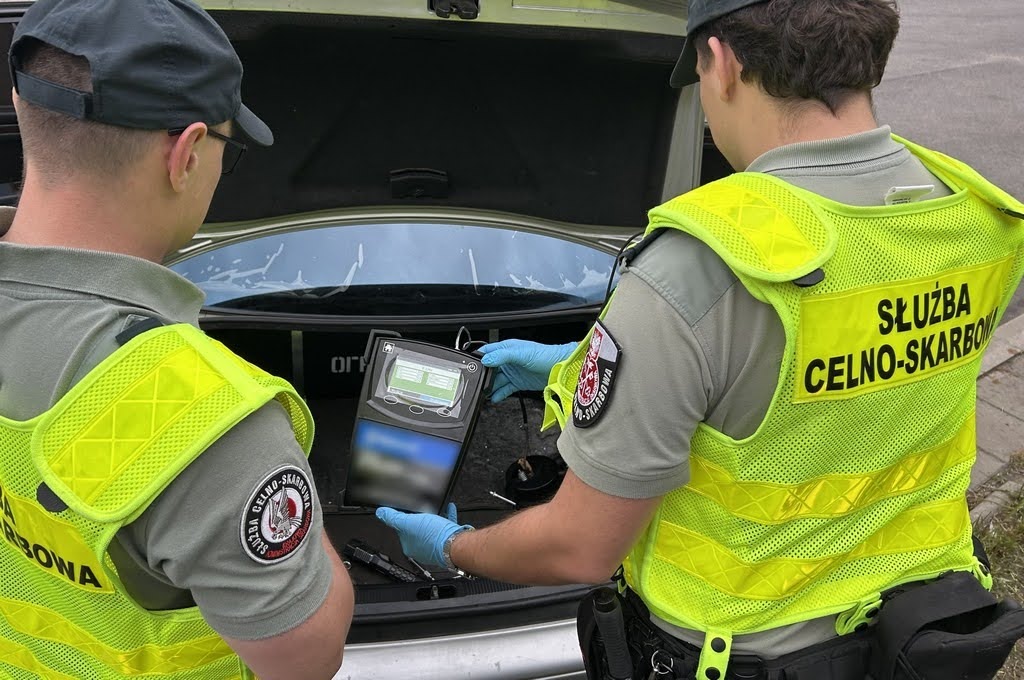
Photos from press release of the Polish Tax Administration Chamber in Białystok, June 12, 2026, available here.
On June 12, 2026, Polish Customs and Tax Service officers discovered modified LPG (liquified petroleum gas) cylinders during an inspection of two vehicles at the Bobrowniki border crossing with Belarus. According to the authorities, the modified LPG cylinders were being used to smuggle over 80 liters of HFC refrigerants, R-404A and R-134a, into Poland. Due to their high GWP (3,922 and 1,430 respectively), the use of these refrigerants is banned in new equipment approved for sale as part of the EU Fluorinated Greenhouse Gas (F-Gas) Regulations that phase down HFCs. The authorities initiated tax criminal proceedings against the two drivers, and seized the smuggled refrigerants and both vehicles. This case highlights how refrigerant smugglers continue to adapt methods for concealing smuggled refrigerants, including in potentially hazardous ways. It also demonstrates the importance of investing in enforcement capacity-building, by providing specialized training and refrigerant identification equipment that help officers detect, identify, and safely handle smuggled refrigerants.
Bulgarian Authorities Investigate Money Laundering and Refrigerant Smuggling
During a specialized operation, officers from the Bulgarian General Directorate for Combating Organized Crime (GDBOP) arrested a group for environmental crimes and money laundering. According to the June 5, 2026 press release, officers detained four individuals, including the suspected leader of the group, and charged two, with one individual charged with money laundering to the amount of 1,548,052 euros (USD $1,783,820). During the investigation, officers searched 10 addresses, and found over 1,500 cylinders of various refrigerants in a warehouse. They seized over 70,000 euros (USD $80,661), as well as jewelry, watches, and gold coins. While the refrigerants seized were not disclosed in the press release, accompanying photographs show pallets of HFC refrigerants including high-GWP R-404A and R-410A.


Bulgarian authorities discover 1,500 cylinders of smuggled refrigerants in a warehouse, photos from the Ministry of Interior’s June 5, 2026 press release, available here.
Authorities note that part of the criminal activities were conducted outside of Bulgaria, and related to the evasion of customs duties for refrigerants originating in China. The suspects used documents with falsified information regarding the origin, quantity, and quality of the goods. The investigation continues, but has already established the import, storage, trade, and distribution of significant quantities of fluorinated refrigerants (both ozone-depleting and greenhouse gases) in Bulgaria and other EU member states, in violation of EU regulations. This enforcement success underscores how illegal refrigerant trade can be closely linked to organized crime networks, bringing together environmental crime, money laundering, customs fraud, and tax evasion.
Criminal Organization Dismantled by Greek Police for Illegal Refrigerant Trafficking
On May 28, 2026, Greek authorities arrested five members of a criminal organization suspected of illegally importing and trafficking large quantities of fluorinated refrigerants from Albania into Greece, with the intent to sell. As part of a coordinated police operation, officers seized 234 cylinders of fluorinated refrigerants, amounting to 2,418 kilograms (5,331 pounds), with an estimated market value of at least 82,237 euros (USD $95,815).
Authorities allege the refrigerant cylinders were imported into Greece without the required certifications, in violation of the National Customs Code and environmental protection legislation. By bypassing customs controls, operating as a criminal organization, the illicit actors also avoided payment of corresponding customs and tax charges. The contents of the seized cylinders were not disclosed in the official press release.


Photos from Hellenic Police Headquarters press release from May 29, 2026, available here.
The investigation continues, and authorities are looking for two additional suspects: the alleged gang leader who is believed to have coordinated the importation and distribution of the refrigerants, and the individual suspected of illegally transporting the cylinders across the Albania-Greece border and temporarily concealing them near the border prior to distribution. Such enforcement actions deliver both environmental and regulatory benefits, reducing the availability of non-compliant refrigerants while protecting legitimate businesses from unfair competition from black market refrigerants.
Enforcement Collaboration for Climate Action
On World Environment Day, June 5th, the UNEP and the World Customs Organisation (WCO) highlighted the importance of stronger environmental enforcement and cooperation between customs and environmental authorities. During the week of June 5, 2026, around 200 participants from customs, law enforcement, environmental agencies, and international organizations met in person or virtually at the WCO to discuss environmental crime, evolving illegal trade methods, and the role of cross-border collaboration in enforcing multilateral environmental agreements, including the Montreal Protocol.
Send us a tip
If you suspect illegal activity related to refrigerants, you may share information with EIA by filling out our anonymous form or emailing us confidentially at [email protected].
Report violations to the EPA
Possible violation of environmental laws or regulations may also be reported to the U.S. Environmental Protection Agency (EPA) here. Information about activities that pose an urgent safety or security threat should be immediately disclosed to relevant authorities.