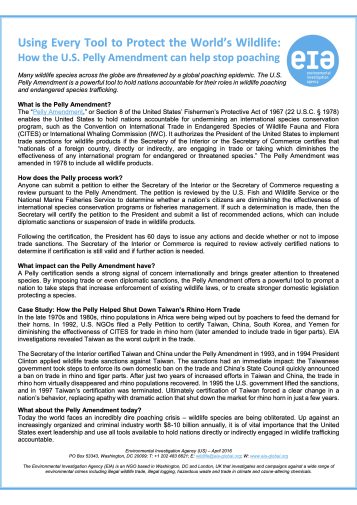
Using Every Tool to Protect the World’s Wildlife: How the U.S. Pelly Amendment can help stop poaching
Read EIA’s brief overview of the Pelly Amendment and its uses and potential impacts.
- Areas of work:

Read EIA’s brief overview of the Pelly Amendment and its uses and potential impacts.
The Dubai Meeting of the Parties to the Montreal Protocol in November 2015 marked a major turning point in the global movement toward phasing down hydrofluorocarbons (HFCs), the super greenhouse gases used in refrigeration and air conditioning. This new briefing provides an overview of factors influencing refigerant performance, and a sampling of the technologies available […]
2015 was the hottest year on record and 2016 is expected to be even warmer. Fifteen of the last sixteen hottest years since records began have occurred since 2001, and January and February 2016 have already set new records. In December 2015 at the 21st Conference of the Parties to the UN Framework Convention on […]
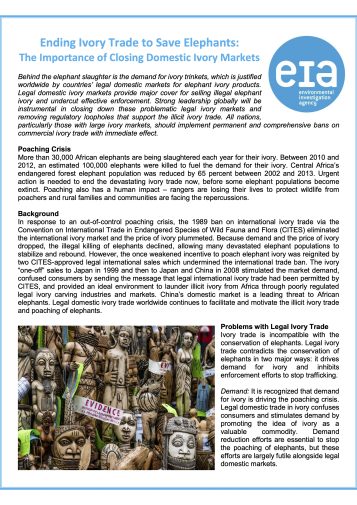
Behind the elephant slaughter is the demand for ivory trinkets, which is justified worldwide by countries’ legal domestic markets for elephant ivory products. Legal domestic ivory markets provide major cover for selling illegal elephant ivory, and undercut effective enforcement. Strong leadership globally will be instrumental in closing down these problematic legal ivory markets and removing […]
As the major intergovernmental forum for the Arctic Ocean, the Arctic Council has always taken its responsibility for environmental protection seriously. Unfortunately, in spite of decades of research, the member nations of the Council have not made serious commitments to new marine protected areas. As the Arctic continues to warm, many species like the beluga […]
Under Japan’s domestic ivory laws, all persons looking to trade elephant tusks must first register them with the Japanese Wildlife Research Center (JWRC) to prove they were imported prior to the 1989 international ban on ivory trade. However, in several phone calls with EIA investigators in 2015, a JWRC official repeatedly offered advice and suggestions […]