Illegal Trade Bulletin: Issue 8
Building Enforcement Capacity and Addressing Market Challenges
This issue of EIA’s Illegal Trade Bulletin highlights new U.S. regulatory changes, a recent U.S. government auction of seized refrigerants, the importance of refrigerant testing, and enforcement capacity-building trainings.
U.S. Prolongs HFC Use in Some Sectors, Increases Illegal Trade Risk
The U.S. Environmental Protection Agency’s May 21, 2026 final rule rolling back certain Technology Transitions Rule requirements under the American Innovation and Manufacturing (AIM) Act, risks undermining efforts to reduce illegal trade in HFCs. The rule prolongs HFC use in the food retail sector to 2032 despite the wide availability of proven alternatives and significant industry support of the original timeline.
The original rule was designed to reduce demand for HFCs in line with the U.S. HFC phasedown under the Kigali Amendment to the Montreal Protocol. A clear technology transition aligned with the HFC phasedown timeline is critical to reducing demand for high-GWP HFCs, incentivizing investments in alternative technologies, and preventing market confusion and sudden price spikes that encourage illegal trade.
The recently imposed regulatory uncertainty and shifting timelines will prolong demand for HFCs and drive up refrigerant costs to the detriment of the food retail industry, and ultimately U.S. consumers. Increased refrigerant costs combined with a phasedown schedule may also contribute to demand for illegally imported refrigerants, as we have seen in earlier phasedowns and are seeing with HFCs in Europe already.
Seized Refrigerants at U.S. Government Auction Remain Unsold
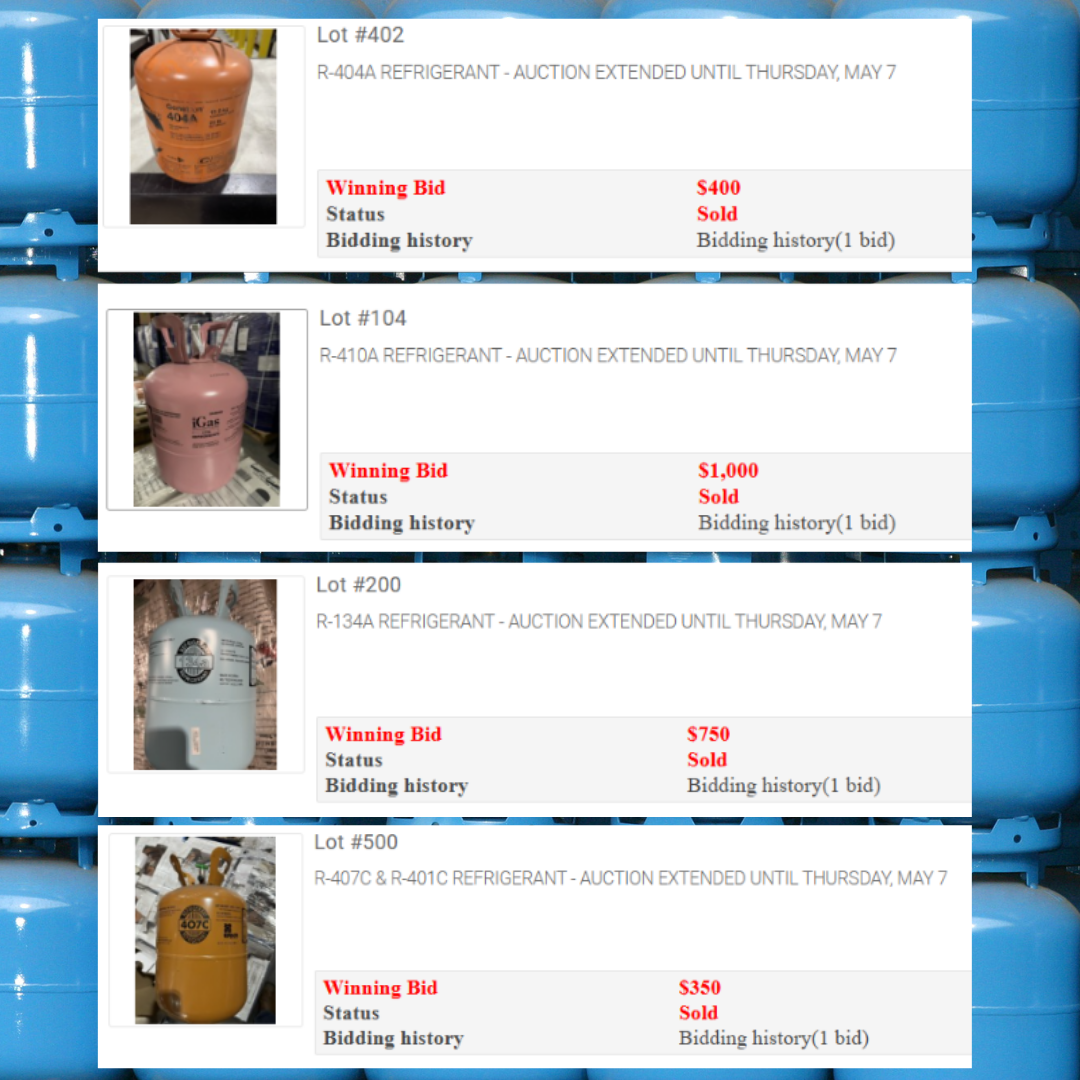
The U.S. Department of Treasury and the U.S. Customs and Border Protection held an auction for seized HFC refrigerants between April 27-30, 2026, later extending bidding to May 7, 2026. The HFCs offered for sale, including R-410A, R-404A, and R-134a, amounted to nearly 16 tons (more than 31,600 pounds), the majority of which had previously been up for auction in February 2026 but remained unsold. An additional 1,060 pounds of seized R-404A, R-410A, and R-407C were added during the recent auction.
At the close of the auction period, only four lots were sold of R-410A, R-404A, R-134a, R-401C, and R-407C, totalling less than 2,000 pounds total, each receiving one bid. It has not been publicly disclosed which HFC allocation holder(s) submitted the winning bids.
As discussed in Issue 5, authorities have several options for managing confiscated refrigerants, including auctions, destruction, or re-export. By bringing these refrigerants into regulatory control, these approaches could provide the opportunity for responsible management, critical to reducing avoidable climate-damaging emissions. Given that illicit refrigerants lack supply chain traceability, and may be counterfeit, contaminated, or mislabeled, refrigerant testing is an important part of the auction process.
According to the auction details, all the refrigerants were offered for sale “as-is” without warranties. Prospective bidders were required to provide their own analyzer equipment during inspection, with testing conducted at their own expense and liability. Buyers also acknowledged that all legally required testing and sampling must be completed prior to resale. These requirements are important safeguards but may discourage allocation holders from using their HFC quota on refrigerants of uncertain origin or purity.
One potential approach to improve future auction participation would be for authorities to conduct Air-Conditioning, Heating, and Refrigeration Institute (AHRI) -certified lab testing in advance, incorporate those costs into the auction pricing, and provide verified testing results for representative samples. For example, as highlighted in Issue 6, Belgian authorities auctioning seized R-134a refrigerant confirmed the contents of four randomly selected cylinders through analysis conducted by the Belgian Customs and Excise laboratory.
In the U.S., AHRI has certified 12 Refrigerant Testing Laboratories (RTLs), with several other locations globally. These laboratories are able to perform AHRI Standard 700 test methods on any new or reclaimed refrigerant to verify composition and determine contamination levels. While some of the RTLs are in-house and do not provide commercial testing, a subset of these independent testing providers advertise complete mail-in sampling kits with quick turnaround times for a nominal fee.

EIA map of AHRI-certified RTLs in the U.S., based on available information from AHRI as of May 2026
It remains unclear what will happen to the approximately 15 tons of refrigerants that remain unsold. Seized refrigerants cannot be stored indefinitely due to the risk of leaks and emissions. At the same time, governments must ensure confiscated refrigerants do not distort the market, undermine phasedown requirements under the AIM Act, or re-enter circulation through illegal trade. This underscores the need to strengthen government auction processes by conducting testing in advance, or other measures that avoid prolonged storage of seized refrigerant stockpiles. Compared to denying entry to illegal refrigerants at the border, seizures followed by proper management reduce the risk that intercepted shipments are redirected and later re-enter the market via similar or different illicit channels.
Montreal Protocol Customs Training in Suriname
EIA participated in a Customs Training Workshop on the Montreal Protocol, held by the Ozone Unit of the Nationale Milieu Autoriteit (NMA) of Suriname on May 25-26, 2026. The training brought together key stakeholders and experts, such as policymakers and officers from the Suriname Standards Bureau and the Suriname Customs Administration.
EIA was invited to lead a session on illegal refrigerant and global enforcement trends, which provided an overview of enforcement challenges, lessons learned, what good enforcement looks like, and highlighted resources. EIA’s presentation ended with a global call to action for strengthening collaboration and leveraging technological advancements for monitoring and enforcement, as well as universally ratifying the Kigali Amendment.

As countries continue to implement hydrochlorofluorocarbon (HCFC) phaseout and hydrofluorocarbon (HFC) phasedown obligations, building enforcement capacity for customs officers to identify controlled substances, detect illegal shipments, and strengthen licensing systems is crucial for effective implementation of the world’s most successful environmental treaty. Many Article 5 countries are already including activities in their Kigali Implementation Plans (KIPs) to provide training and resources that support capacity-building for enforcement and customs and illegal trade prevention.
2026 marks the 10th anniversary of the Kigali Amendment, a timely opportunity to strengthen global cooperation and much-needed investment in the prevention of illegal refrigerant trade.
Train-the-Trainer: Building Enforcement Capacity
During the week of April 20, 2026, the Africa Centre of Excellence for Sustainable Cooling and Cold-Chain (ACES) held a two-day training workshop in Kigali, Rwanda, for customs and enforcement agencies. The training centered on monitoring refrigerant and cooling equipment imports and strengthening enforcement capacity to combat illegal trade. The workshop emphasized awareness-building, cooperation, and the transfer of knowledge through a “Train-the-Trainer” approach. The collaboration between ACES, the United Nations Environmental Programme (UNEP), and the Rwandan Environmental Management Authority brought together stakeholders from customs, revenue, consumer protection, and law enforcement agencies. Illegal trade remains a significant challenge to the phasedown of ozone-depleting and greenhouse gases under the Montreal Protocol and Kigali Amendment.
Send us a tip
If you suspect illegal activity related to refrigerants, you may share information with EIA by filling out our anonymous form or emailing us confidentially at [email protected].
Report violations to the EPA
Possible violation of environmental laws or regulations may also be reported to the U.S. Environmental Protection Agency (EPA) here. Information about activities that pose an urgent safety or security threat should be immediately disclosed to relevant authorities.